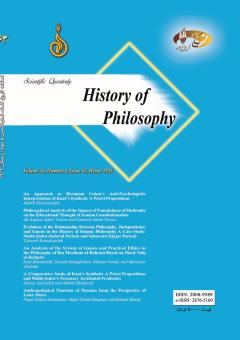
A Comparative Study of Kant’s Synthetic A Priori Propositions and Mullā Ṣadrā’s Necessary Accidental Predicates
Subject Areas : Comparative studies in the field of history of philosophy
Naser Azizvakili
1
*
 ,
Mahdi Monfared
2
*
,
Mahdi Monfared
2
*
1 - PhD in Comparative Philosophy, University of Qom, Qom, Iran
2 - Associate Professor, Department of Islamic Philosophy and Kalam, University of Qom, Qom, Iran
Keywords: necessary accident, synthetic a priori propositions, Kantian philosophy, Sadrian philosophy,
Abstract :
Every philosopher, in their research, seeks to pose and answer a fundamental question. Kant's most important issue in the Critique of Pure Reason is synthetic a priori propositions and their possibility. The importance of these propositions in Kant’s view is such that wherever he discusses natural sciences, mathematics, and metaphysics, he begins his discussion with synthetic a priori propositions; as if the possibility of science or its affirmation and negation is related to the possibility of synthetic a priori propositions. On the other hand, years before Kant, in Sadrian philosophy and alongside issues such as the common technical predication and necessary accidental predicates, some philosophers discussed predicates that are conceptually different from their subject but are necessarily predicated of it. With a little attention, we realize that such predicates enjoy the characteristics of synthetic a priori propositions, including necessity and universality. The present paper aims to discuss Kant’s view on synthetic a priori propositions and demonstrate that his problem in epistemology was also raised in Mullā Ṣadrā’s philosophy. Moreover, it tries to show that, by relying on the teachings of Sadrian philosophy, such as the necessary accidental predicate, synthetic a priori propositions can be attained. However, the problem of this research is not merely a re-reading of two independent philosophical systems; rather, it attempts to align Kant’s and Mullā Ṣadrā’s theories regarding synthetic a priori propositions.
ابنسینا (١٣٧٥) الاشارات و التنبیهات، قم: نشر البلاغه.
ابنسینا (١٤٣٣ق) الشفا، قم: کتابخانۀ آیتالله مرعشی نجفی.
ابوترابی، احمد (١٣٩٤) چیستی و نقش قضایای تحلیلی و ترکیبی در منطق و معرفتشناسی، قم: مؤسسۀ امام خمینی (ره).
اسپینوزا، باروخ (1376) اخلاق، ترجمة محسن جهانگیری، تهران: مرکز نشر دانشگاهی.
اعوانی، غلامرضا (1386) قضایای ترکیبی ماتقدم در کانت، ابنسینا و ملاصدرا، تهران: مؤسسۀ حکمت و فلسفه ایران.
دکارت، رنه (1392) تأملاتی در فلسفه اولی، ترجمة احمد احمدی، تهران: سمت.
شهرزوری، شمس¬الدین (1373) شرح حکمت¬الاشراق، تهران: مؤسسۀ مطالعات و تحقیقات فرهنگی.
طوسی، نصیرالدین (١٣٧٥) شرح الاشارات و التنبیهات، قم: نشر البلاغه.
غفاری، حسین (1390) بررسی مبادی فلسفه نقادی، تهران: حکمت.
غفاری، حسین (1396) معرفتشناسی در فلسفه اسلامی، تهران: حکمت.
کانت، ایمانوئل (۱۳۸۳) رسالۀ کشف، شرح و توضیح هنری آلیسون، ترجمۀ مهدی ذاکری، تهران: دانشگاه مفید.
کانت، ایمانوئل (١٣٩1) تمهیدات: مقدمهای برای هر مابعدالطبیعه آینده که بهعنوان یک علم عرضه میشود، ترجمۀ غلامعلی حداد عادل، تهران: مرکز نشر دانشگاهی.
کانت، ایمانوئل (1396) نقد عقل محض، ترجمة بهروز نظری، تهران: ققنوس.
لاک، جان (1399) مقالهای درباره فهم بشری، ترجمة کاوه لاجوردی، تهران: نشر مرکز.
مشکوةالدینی، عبدالحسین (1362) منطق نوین، مشتمل بر لمعات المشرقیة فی العلوم المنطقیة، تهران: آگاه.
ملاصدرا (1383) الحكمة المتعالیة فى الأسفار الأربعة، ج1، تصحیح و تحقیق غلامرضا اعوانی، تهران: بنیاد حکمت اسلامی صدرا.
ملاصدرا (1391) التنقیح فی علم¬المنطق، تصحیح و تحقیق غلامرضا یاسیپور، تهران: بنیاد حکمت اسلامی صدرا.
هارتناک، یوستوس (1387) نظریه معرفت در فلسفۀ کانت، ترجمۀ غلامعلی حداد عادل، تهران: هرمس.
هایدگر، مارتین (۱۴۰۰) کانت و مسئله متافیزیک، ترجمة مهدی نصر، تهران: روزگار نو.
هیوم، دیوید (1402) در باب فهم آدمی، ترجمة جلال پیکانی، تهران: ققنوس.
Allison, H. E. (2004). Kant’s transcendental idealism: An interpretation and defense. Yale University Press.
Bealer, G. (1998). Intuition and the autonomy of philosophy. In M. DePaul & W. Ramsey (Eds.), Rethinking intuition: The psychology of intuition and its role in philosophical inquiry (pp. 201–240). Rowman & Littlefield.
Berkeley, G. (2008). A treatise concerning the principles of human knowledge. ed. by J. Dancy. Oxford University Press.
Bonjour, L. (1998). In defense of pure reason: A rationalist account of a priori justification. Cambridge University Press.
Casullo, A. (2003). A priori justification. Oxford University Press.
Guyer, P. (1987). Kant and the claims of knowledge. Cambridge University Press.
Heidegger, M. (1997). Kant and the problem of metaphysics (5th ed.). trans. by R. Taft. Bloomington: Indiana University Press.
Hume, D. (2007). An enquiry concerning human understanding. ed. by P. Millican. Oxford University Press.
Kant, I. (1998). Critique of pure reason. trans. by P. Guyer & A. W. Wood. Cambridge University Press.
Leibniz, G. W. (1989). Philosophical essays. trans. by R. Ariew & D. Garber. Hackett Publishing.
Leibniz, G. W. (1996). New essays on Human understanding. trans. by P. Kemnant & J. Bennett, Cambridge University Press.
McDowell, J. (1994). Mind and World. Harvard University Press.
Ruja, H. (1936). A critique of the postulational theory of the a priori. USA, Princeton University.
Smith, N. K. (2003). A commentary to Kants critique of pure reason. (3rd edcition). New York.
Smith, N. K. (2012). Synthetic a priori knowledge in Kant’s philosophy. Oxford University Press.