
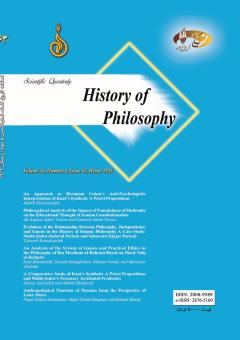
An Approach to Hermann Cohen’s Anti-Psychologistic Interpretation of Kant’s Synthetic A Priori Propositions
Subject Areas : Interation of thoughts, effects of philosophers’ ideas on society and future philosophical standpoints
1 - Assistant Professor, Iranian Institute of Philosophy, Tehran, Iran
Keywords: synthetic a priori, psychologism, Hermann Cohen, transcendental method, common experience, mathematical natural science,
Abstract :
The most important problem in Immanuel Kant’s epistemological system concerns synthetic a priori propositions. Some Kantian commentators have criticized Kant by offering a psychological interpretation of his philosophical system. Hermann Cohen, the German philosopher, is one of the commentators of Kant's epistemological system who, contrary to this group, strongly avoids a psychological interpretation of Kant’s philosophy and, by offering a new reading of synthetic a priori propositions, subjects such interpretations to criticism. In his interpretation, he posits three planes for synthetic a priori propositions and refers the third plane to common experience. For this purpose, he starts from “space” and, by reflecting on the meaning of space, arrives at three planes of a priority: 1) space as something prior to any other sensory matter; 2) space as form; 3) space as the formal condition of the possibility of experience. By using the third level of a priority, Cohen absolves Kant from accusations of subjectivism. He considers the source of third-degree a priori propositions to be the principles of mathematics and the fundamental laws of pure natural science, i.e., mechanics, which are deemed to be objective matters. He believes that these principles and laws constitute the possibility of experience. This experience, unlike personal experiences, is universal and common to all individuals. In his view, the function of philosophy is to arrive at third-degree a priori principles by reflecting on this mathematical natural science. Such a science is variable in every era and, consequently, a priori propositions will also differ in every era.
Beiser, Frederick C. (2014). The Genesis of Neo-Kantianism, 1769 – 1880 (First ed). UK: Oxford university press.
Borchert, Donald M. (2006), Encyclopedia of philosophy (2nd ed) , USA: Thomson Gale.
Cohen, Hermann (1871). Kants theorie der Erfahrung. Berlin, Dummlers (First ed).
Cohen, Hermann (1885). Kants theorie der Erfahrung. Berlin, Dummlers (Second ed).
Edgar, Scott (2015), "Hermann Cohen", The Stanford Encyclopedia of Philosophy, Edward N. Zalta (ed.). URL =
Biagioli, Francesca (2018). " Cohen and Helmholtz on the Foundations of Measurement", Philosophie und Wissenschaft bei Hermann Cohen / Philosophy and Science in Hermann Cohen. Christian Damböck (ed.). Germany: Institut Wiener Kreis.
Holzhey. Helmut (2005). "Cohen and Marburg school", Hermann Cohen's critical idealism. Reinier Munk (ed.). The Netherlands: Springer.
Kant, Immanuel (2002). Critice of pure reason (translated and edited by Paul Guyer & Allen W. Wood) (First ed.). UK: Cambridge University Press.
Moynahan, Gregory B. (2018). " The Challenge of Psychology in the Development of Cohen’s System of Philosophy and the Marburg School Project ", Philosophie und Wissenschaft bei Hermann Cohen / Philosophy and Science in Hermann Cohen. Christian Damböck (ed.). Germany: Institut Wiener Kreis.
Poma. Andrea (1998). The Critical Philosophy of Hermann Cohen (La Filosofia Critica DI Hermann Cohen) (Translated by Johan Denton) (First ed). USA: State University of NewYork Press.
Stang. Nicholas F. (2018). "Hermann Cohen and Kant’s Concept of Experience", Philosophie und Wissenschaft bei Hermann Cohen / Philosophy and Science in Hermann Cohen. Christian Damböck (ed.). Germany: Institut Wiener Kreis.