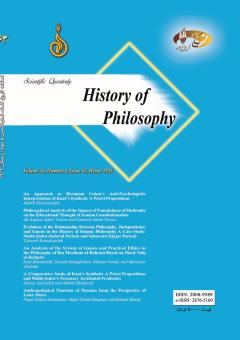
Anthropological Function of Pneuma from the Perspective of Later Stoics
Subject Areas : Geneology of philosophical schools and IdeasNegar Ezhari Jenekanloo 1 , Majid Yarian Koupaei 2 * , Raham Sharaf 3
1 - PhD candidate of Islamic Philosophy and Kalam, University of Zanjan, Zanjan, Iran
2 - Assistant Professor, Department of Philosophy, University of Zanjan, Zanjan, Iran
3 - Associate Professor, Department of Philosophy, University of Zanjan, Zanjan, Iran
Keywords: Pneuma, Soul, Body, Logos, Cosmos, Later Stoics,
Abstract :
The present paper aims to investigate the mediating role of pneuma in explaining the soul-body relation from the Stoics’ perspective. Unlike dualistic philosophical traditions, the Stoics introduced pneuma as a force that simultaneously possesses both physical and rational dimensions and acts as a connecting element between these two realms. In Stoic philosophy, this component is not merely a biological concept, but the most fundamental explanatory principle for the coherence of a living organism, the mechanism of sensory perception, and rational actions. Here, the authors demonstrate that pneuma, as an active and dynamic substance permeating the entire world, plays three key roles in the Stoic philosophical system: first, it is a force that maintains the body’s structure and coherence and enables vital activities; second, it is a mediator between the soul and the body, forming a structure of “mixtures”; third, at the metaphysical level, it is linked to the Logos (cosmic reason) and plays a role in creating the harmony between the human soul and the entire cosmos. This study, using a descriptive-analytical method, aims to identify the role of pneuma as a mediator for the fundamental mechanism in explaining the nature and functions of the physical and rational dimensions of humans by analyzing some classical Stoic texts (with reference to the views of Seneca, Epictetus, and Marcus Aurelius). By resorting to studies on the relationship between pneuma and concepts such as Logos and cosmic normativity, the authors try to show that this element not only plays a role in explaining the biological and cognitive functions of the individual but also, at a broader level, holds a fundamental position in the Stoic philosophical system as a force that ensures cosmic order and harmony.
اسماعیلی، محمدجواد؛ مشایخی، سینا (1394) «نظریه اتصال در طبیعیات رواقی»، مجله تاریخ فلسفه، شمارۀ 25، ص96ـ65.
برن، ژان (1362) فلسفه رواقی، ترجمۀ سیدابوالقاسم پورحسینی، تهران: امیرکبیر.
کامتکار، راچانا؛ گریور، مارگارت (1396) اورلیوس و اپیکتتوس از دانشنامۀ فلسفه استنفورد، ترجمۀ عفت جهانی، تهران: ققنوس.
Arenson, K. (2020). The stoic theory of soul. Routledge Handbook of Hellenistic philosophy. London: Routledge.
Aurelius (1890). the thought of the emperor Marcus Aurelius Antonius. Philadelphia: Henry Altemus duke-Libraries.
Aurelius (1925). the golden book of Marcus Aurelius. London: J. M. Dent.
Aurelius (2008). the essential Marcus Aurelius. Jeremy Tarcher Penguin.
Aurelius (n.d). Meditations Marcus Aurelius. translated by George Long. Standard EBook's CCo100 universal.
Boeri, M. (2010). The stoic psychological physicalism. The New Centennial Review, vol. 10, No. 3, pp. 105-132.
Bogomolov, A. S. (1995). History of Ancient philosophy Greece and Rome. translated by Vladimir Stankevich. Moscow: Progress publishers.
Brehier, E. (1908). La theorie des incorporels dans l'ancien stoicism (microform), Paris: A. Picard.
Brennan, T. (2009). Stoic souls in stoic corpsos. Cornall University.
Bronowski, A. (2019). The stoics on Lekta: All there is say. Oxford University press.
Dherbey, G. (2005). Le stoiciens. Voir Maximillian forschner, Le portique ET le concept de personne, dans, Paris/ VIN.
Gourinat, J. (2018). The ontology and syntax of stoic causes and Effects. Rhizomata, vol. 6, no. 1, pp. 87-108.
Gruyter, W. (2013). Bodies and their Effects: The stoics on causation and incorporeal. Institute de humanidade, Universidad Diego Portales Ejercito.
Harven, V. (2012). The coherence of stoic Ontology. PhD thesis at University of California.
Heller, Robert (2018). Pneuma in Early stoicism. Doctoral Thesis in Royal Holloway university of London.
Kostara, S. (2021), The Potential of the Human Soul towards a Life in Harmony with Nature and Logos as Per the Stoic Psychology. Department of Pastoral Studies, Supreme Ecclesiastical Academy of Athens, Athens, Greece.
Long, A. A. & Sedley, D. N. (1987). The Hellenistic philosophers. New York: Cambridge University press.
Long, A. A. (1982). Soul and body in stoicism. Phronesis. Vol. 27, no. 1, pp. 34-57.
Long, A. A. (2017). Seneca and Epictetus on body, mind and dualism. Plato or Platonism in Seneca and Epictetus. From stoicism to Platonism. ED. T. Engbery.
Norrlof, C. (2019). Hegemony. Oxford Bibliographies.
Quin. C. (1994). The soul and the pneuma in the function of the nervous system after Galen. Journal of the royal society of medicine. vol. 87, no. 7, pp. 393-395.
Robertson, P. (2014). De-spiritualizing pneuma, modernity, religion and anachronism in the study of Paul. Method and theory in the study of religion. Brill Department of religious studies, George Brown university.
Sambursky Samuel (1971). Physics of the stoics. London: Hutchinson.
Sellars, J. (2010). Stoic ontology and Plato's Sophist. Bulletin of the institute of classical studies. No. 107, Oxford University press.
Seneca, Lucius Annaeus (1917). Seneca. Cambridge: Harvard University press.
Stead, Christopher (1998). Pneuma. Routledge encyclopedia of philosophy. London: Routledge.